


Alright. This is going to be an… eccentric one. Bear with me, this is half going to be a game review and half going to be a policy piece. Yes, I’m completely serious. No, I haven't completely lost it (yet). But I was struck with inspiration after casually listening to a playthrough of the esoteric indie game Baby Steps, enough to pick up the game myself and write this piece.
As a Background
I want to spend some time today talking about an unavoidable problem that I have been trying myself to avoid for some time simply because it’s hard to confront and engage with—in part because I am part of the target demographic. It’s broadly been termed the “manosphere,” and while that label for policy purposes is both annoyingly too narrow and too broad, for posterity and brevity alike, we’ll describe it as a mostly decentralized social network of content creators and consumers promoting male superiority and all the troublesome problems that come with it (toxicity, etc.). And there’s a market for it.
If you're not already familiar with the concept, the actual manosphere content certainly isn't worth your time, but it is important to know that there is a very real and significant following amongst particularly young men. And while this is oversimplifying the matter quite a bit: roughly, the broader affordability issues affecting many developed nations, instead of being viewed as the systemic economic and policy failures that it is, is instead viewed as the failures of feminism and diversity, equity, and inclusion (DEI) policies. It's a reactionary force, but it's reactionary to the wrong issues.
This manifests itself slightly differently in different contexts, from “incel” (involuntary celibate) culture to “MGTOW” (Men Going Their Own Way, i.e. avoid women as much as possible). There even exists a somewhat-mirrored market for content for male superiority directed at women, often called “tradwife” (for traditional wife). Different countries experience it differently. In South Korea, for example, the divide between young men and women is so severe that 79% and 70% of men in their 20s and 30s respectively believe that South Korean men face structural discrimination.
Of note, most conversation around potential policy fixes looks at the marketplace: while the conversation around cracking down on social media platforms is largely dead in the current U.S. administration, many other jurisdictions, including the E.U., Canada, and Australia are actively looking to combat the problems that social media exposes and platforms. But I view this as somewhat akin to merely treating the symptoms. Yes, it is definitely a problem and there are good conversations being had and left to be had, but it fails to address the underlying structural problems. Young men are upset because they feel like they don’t have the same possibilities for a future as their parents. How many young people have giving up on the idea of ever owing a house? How many would want to have kids, but it’s not financially viable for them? How many live with their parents simply to save money? These problems, our parents simply didn’t have to deal with like this; many of whom still deny that such a problem could exist now. I agree with professor Seungsook Moon’s assertion (from the above linked Guardian piece) that much of the core of the issue in South Korea today involves the embrace of neoliberalism, and would expand that to say while other legal jurisdictions, like the United States, took a distinct and different path, the destination has been very similar. More succinctly, that with the embrace of neoliberalism came issues that few wanted to solve (or didn’t expect to have to solve), particularly with how the middle class has shrunk.
In other words, an amount of global masculine insufficiency exists now owing to broader socioeconomic factors. But properly addressing these issues now, several decades into the mix, is going to be quite difficult. And it's ultimately not what this piece is about. This is not going to be an overnight fix, but we have to make some progress. Where I want to go with this is less the policy route: while I think the ultimate solution is found in policy and regulation, there is much to contribute outside of the policy world in broader society. Enter Baby Steps.
The Premise
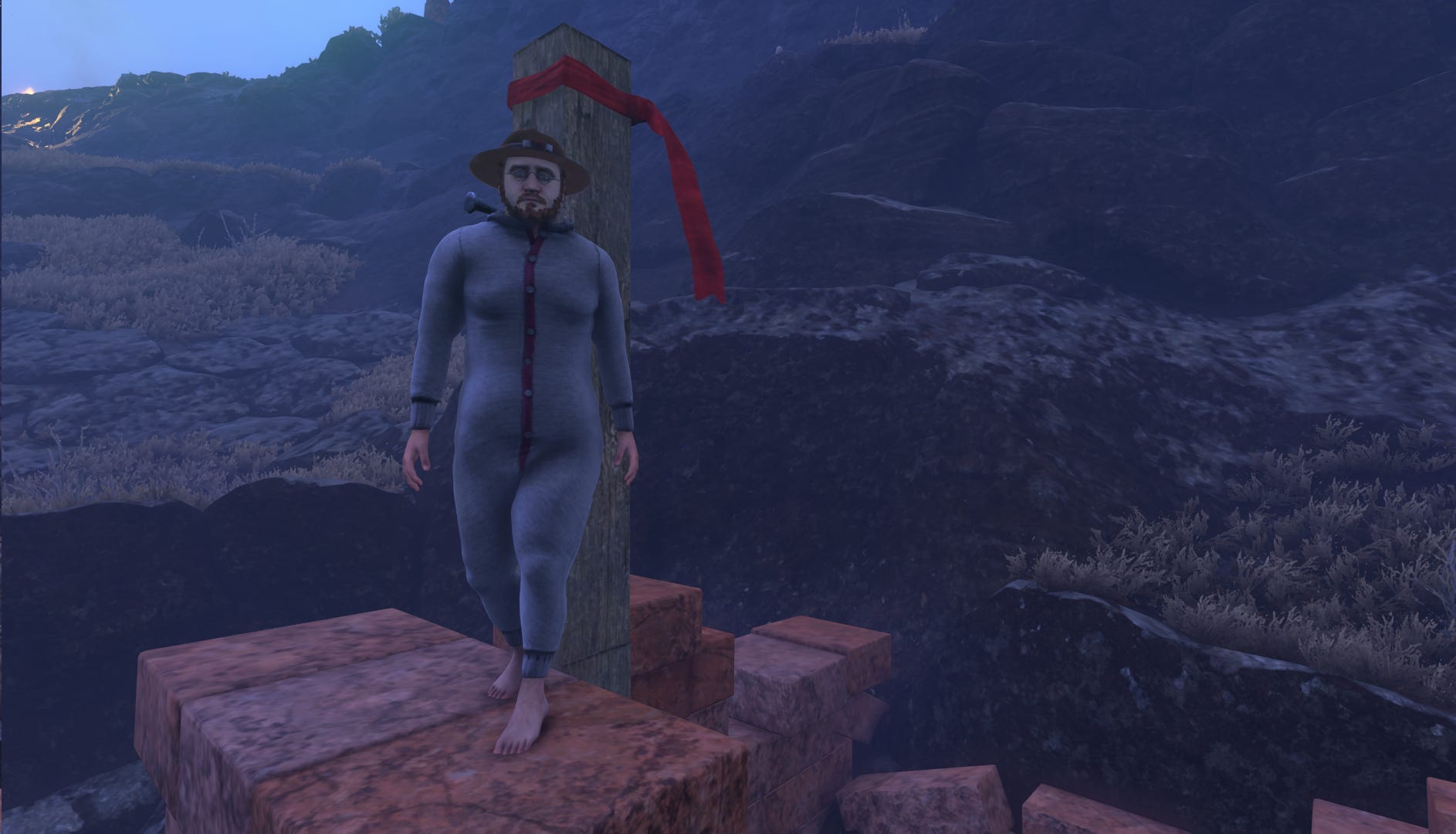
You play as Nate, a 35-year-old, socially awkward, basement-dweller. The game opens on Nate distantly hearing his parents upstairs arguing about kicking him out (or giving him some such similar ultimatum), before abruptly getting isekai’d (or wardrobe’d if you’re a C. S. Lewis reader) into another world. Nate is not anything resembling your traditional masculine hero in media, except that he’s quite a bit hard-headed and has trouble in asking for help, electing to do everything himself. These character traits are established very quickly as he refuses help in learning how the world works, refuses shoes to help him walk more easily, and refuses a map to show him where he’s going. Thanks, Nate.
The goal of the player is straightforwardly to climb the mountain in front of Nate. The reason? Nate has paruresis, better known as a shy bladder, and there aren’t many places to urinate “properly.” And so the player starts hiking to find such a place. As the game progresses, Nate is forced in a number of ways to confront himself: the world around him keeps bashing his stubbornness and other flaws over his head.
The plot unfolds naturally over the course of the game, with story events occurring at landmarks the player hikes to. There are a handful of side challenges along the way with little reward except additional cutscenes, but that’s a surprising amount of value in this game, as the absurd humor present in the cutscenes is a driving part of what makes the game interesting enough to continue.
The Change
I exchanged some words with Bennett Foddy, one of the game co-creators, about how the game’s characterization developed. Fellow co-creator Maxi Boch pointed out the Pinocchio-esque nature of Nate's initial lying about needing help, which kicked off the story’s development.
…as a group we found [we] wanted to explore ideas that are opposite the morality parable in Pinocchio—it felt boring and inauthentic for Nate to “learn a lesson” or overcome his problems.
Nate never really fixes his issues, which I fully agree would seem boring and inauthentic. People don't typically “learn a lesson” and have a full 180: it is almost always a process of unlearning bad habits. Nate doesn't lose his stubbornness, but he starts the process of turning it into tenacity. Nate doesn't drop his issues in asking for help, but he becomes less afraid to actually admit to himself that he might need help. It's that transformation of a negative character trait into a character trait that still has well-defined negative aspects but with a positive upside. It shows the beginning of that internalization and the start of that process of change. Baby Steps, if you will.
I won’t spoil the game for this piece because I believe there’s value in playing it. But I do want to highlight the climax in particular. Skip this paragraph if a vague paragraph will harm the potential enjoyment of the game. The player can see the climax coming… if the player is familiar with that path or is thinking beyond the game. If not? It hits like a truck and recontextualizes your entire journey. As society becomes more aware of mental health struggles (and some factions become more entrenched against it), it’s important to actually have conversations about it. Not only at the societal level, but also at the personal one. Talking about depression in theory is vastly different than going through it. Experiencing an anxiety attack feels nothing like how people academically or medically talk about anxiety. And the typical “masculine” figure in media doesn’t have these struggles or unhealthily ignores that he has them. To this end, credit where credit’s due, Baby Steps feels like it handles it very well. The aftermath of the climax feels exactly like what should be expected: in a different game, I would not hesitate to describe the next section as “too long,” but it fits snugly with the emotional theme of the game (and the mechanical one, the fact that it’s a “rage” game, but that feels wholly secondary).
The Reflection
Having a flawed main character is nothing new, of course, but I cannot for the life of me think of another example where the character’s flaws (independent of player agency, that is) result directly in increased struggle for the end consumer. Sure, we watch horror movies and the characters often make bad decisions that make the viewing experience less comfortable, but it’s more akin to a toddler on the payroll of the cinema kicking your shins while trying to watch that movie. It's such a well-done story beat and frames the game well. That internal struggle externalizes perfectly in the medium.
It’s uncomfortable in its relatability, but the style of humor makes the discomfort sneak up on you. It’s so ridiculous that the natural discomfort of addressing reality in a media typically meant for escape surprises you. No one in real life acts like Nate does. No one in real life acts like any of the side characters do. And yet Nate is still oddly relatable, in some aspects.
Yes, the game is very direct in its literary meaning. Baby Steps is allegoric for Nate taking his first steps into mature adulthood, his first understanding of what a healthy masculinity can look like, and his first steps into fixing some of his deeply-set problems. And also literally in that one of the side characters implies that he has small feet (and therefore takes small steps), and that the player slowly gets better at the game while playing it. There’s nothing really hidden to uncover in its symbolism. I don’t think art needs to be so obtusely layered that even the artist forgets the inner nature of it, though. And speaking from a U.S. perspective where 54% of adults read below the equivalent of a sixth-grade level (expected of 11-12 years’ old children, for outside context), I think that this serves the game better, as it’s more broadly applicable in its messaging.
In conducting background research on other reviewers and commentators in preparation for writing this piece, I noticed that one consistent through line in these pieces is pointing out Nate’s characterization and his relationship to the world around him and how it feels like a cohesive whole. Through this and everything I’ve written above, I’ve come to the conclusion in the middle of making a recherché rage game that the co-creators of Baby Steps struck pay dirt. It’s an enrapturing indie title where somehow the frustration of playing a game of its ilk is less felt and it’s almost like you don’t want to keep playing because you as the player want to be successful, you keep playing because you want to see Nate be successful. And that subtle transformation is nearly unique across the medium.
If you are the right demographic for what exists in the realm of the “manosphere,” I would actually encourage you to play Baby Steps. Slowly, and prioritizing the journey over completion. Maybe you’ll think I’m overstating the importance of non-social medias. Maybe you’ll think I’m insane for recommending it. And honestly, that’s probably fair. But maybe at least you’ll appreciate it for what it is and reflect on it like I have. Outside that demographic, I have to imagine it’s a more relatively straightforward rage game with a grounded story. For what it’s worth, I don’t personally enjoy these type of games—I hate being angry or even seeing or listening to others’ frustration because I want to help solve rather than dwell on that typically negative emotion—making it more noteworthy to me that I took any interest with this game. And to that, I had originally entirely written it off for that very reason.
After Baby Steps, I went back and absorbed a few other pieces of media, and somewhere on the lines of intentionally and unintentionally found myself drawing comparisons. As an example, I sat with Mulan, the Disney animated classic (not the live-action remake), and wondered why I never considered that beyond Mulan/Ping’s understanding and growth in femininity as a reflection to the problematic masculine environment that she existed in, is a growth and understanding of a broader, healthier masculinity as well. While unfortunately the male lead is a bit exempt from this (I would have loved even half a scene of actual reflection on Li Shang’s part), and acknowledging how exemplary Mulan had to be to effect the change that she did, it had me thinking about the wider effect of more traditional medias on addressing the pitfalls of strict gender roles from the masculine perspective, as well. Part of why Mulan is so effective in its messaging of feminine empowerment is that it doesn’t shy away from the perceived role of women in that society, which is grounded in real experiences. The target audience doesn’t have to match any of Mulan’s character traits or demographics to identify with the character simply because her lived experience is relatable. And that brought about a bigger question for me, is there a Mulan for masculine empowerment?
Traditionally, we haven’t needed it as men have occupied the lion’s share of privilege in society. So no, I am not saying that Baby Steps is “Mulan for Men.” But I am saying that the existence of Baby Steps caused me to appreciate Mulan more. I am not represented by Mulan. I don’t need to be to appreciate Mulan. It's a fantastic movie. But the thing I realized from Baby Steps is that despite that I thought I understood what representation in media meant and in advocating for it (please, I love learning about other cultures and appropriate media representation is a great way to do it), I didn't realize that I myself never felt particularly represented in media. It's weird to be on the other side of it—I don’t personally feel like I need media representation (after all, “default white man” is an unfortunately standard thing across media experiences) and yet I can't deny its effects. I somewhat unfortunately somehow resonate with the struggles of this frumpy, mid-30s, socially awkward loner… and it makes me think that I can't be alone in that experience. I recognize that this piece feels a bit like “policy wonk finds world exists outside policy,” but I wanted to take a second to acknowledge that those of us researching problems typically want to address the base cause, and I hoped to share an experience that made me think harder about the broader role of media in society.
Bringing it Together
Which is all to say that I had to take a pause to reflect on all this. I know, as many others do, if not the broader strokes, at least the checkpoints needed to correct the demand that the manosphere supplies. But it’s admittedly easy to talk about in theory and hard to bring about in practice. Add to that a complete solution is probably off the table for now. I also tend to view stop-gap, compromising policy/regulation half-measures as unfavorable because I find it tends to cause a sort of regulatory complacency—in jurisdictions like the U.S. where the conversation has fully stalled, though, doing nothing is regressing us further.
But while the politics is stalled, that doesn’t mean everyone else has to give up and do nothing. And the societal value in creating something like Baby Steps is at least in part to fulfill that demand from a different angle. Are there other ways that this demand could be fulfilled? Absolutely! Therapy is maybe the obvious one, but the point here is that a game like Baby Steps is subtle in fulfilling that demand; the opportunity cost taking in a different form of media is only a small pill to swallow. And Baby Steps of course didn’t set out to fix the manosphere problem, its creators just chose to take a real stab at masculine insufficiency, and it works because it’s clever and well-done.
All that to say that yes, we should be looking at the data to evaluate regulation and policy around social and traditional media platforms that allow for hatred to spread. But unfortunately, endemic socioeconomic issues means that even harsh changes will simply move the market for that hatred in the short run. In the meantime, we can and should look at other ways to supply that simple, base need of being heard. And a very straightforward way to do that is to embrace it head on, acknowledge the problems and give actual representation. But to that, while media can only be a part of the solution, media creators can supply the demands of fragile masculinity in ways besides giving into hatred, taking baby steps towards addressing the issues.